Why Miami’s Climate Makes Concrete Waterproofing a Structural Necessity, Not an Upgrade
Most property owners treat concrete waterproofing like an optional finish — something you do after everything else is built. In Miami, that mindset costs you the structure itself. The combination of 60-plus inches of annual rainfall, relative humidity that rarely drops below 70%, aggressive chloride-laden air from Biscayne Bay, and a water table that sits just 4 to 6 feet below grade in many neighborhoods creates a four-front assault on unprotected concrete. Carbonation accelerates. Chloride ions penetrate paste matrices. Rebar begins corroding before you see a single surface crack. By the time spalling appears, the damage has been progressing for 18 to 36 months underneath. This guide gives you the technical roadmap to stop that process before it starts — or reverse it when it’s already underway.
Diagnosing the Moisture Pathway Before You Apply Anything
Applying a waterproofing membrane to concrete without understanding where water is entering is one of the most expensive mistakes in this trade. You’ll trap moisture, blister the coating, and accelerate the very deterioration you were trying to prevent. The first step is always a moisture vapor emission rate (MVER) test using the calcium chloride method per ASTM F1869, or an in-situ relative humidity probe per ASTM F2170 for slabs on grade.
In Miami, slabs on grade routinely test above 10 lbs per 1,000 sq ft per 24 hours — the threshold above which most topical coatings will fail. If your readings are that high, you’re dealing with hydrostatic pressure from below, not just surface moisture. That changes your entire system selection. Positive-side waterproofing (applied to the wet face) requires either crystalline chemistry or a bentonite-based sheet membrane. Negative-side systems work only when you have access to the dry side and the structure can tolerate some moisture migration.
For walls, use a phenolphthalein indicator test to check carbonation depth. Spray it on a freshly broken concrete face — pink means alkaline and sound, colorless means carbonated and compromised. Carbonation depth beyond 20mm in a 50mm cover zone means your rebar is at immediate risk and waterproofing alone won’t save the structure without concurrent repair.
Selecting the Right Waterproofing System for South Florida Concrete
Crystalline Waterproofing for Below-Grade and Submerged Applications
Crystalline waterproofing compounds — products like Xypex, Krystol, or Penetron — work by reacting with free lime and moisture in the concrete matrix to form insoluble calcium silicate hydrate crystals inside the capillary pores. The critical advantage in Miami’s conditions is that these crystals are self-sealing. If a hairline crack develops later due to thermal movement or minor settlement, the crystalline chemistry reactivates in the presence of moisture and reseals the crack up to approximately 0.4mm wide.
Application is straightforward but surface prep is non-negotiable. The concrete must be saturated surface dry (SSD) — damp but with no standing water — and all laitance, form release agents, curing compounds, and contaminants must be removed by shot blasting or scarification to ICRI CSP 3 to CSP 5 profile. Mix crystalline slurry to a creamy consistency and apply in two coats by brush, working perpendicular strokes between coats. Minimum coverage is typically 1.5 kg/m² for below-grade walls and 2.0 kg/m² for water-retaining structures like pools or cisterns.
If you’re dealing with a pool deck or surrounding concrete structure, our team handles the full scope. See our detailed work on pool demolition and reconstruction projects where waterproofing integration is part of the rebuild sequence from day one.
Polyurethane and Polyurea Coatings for Above-Grade Exposed Slabs
For parking decks, rooftop terraces, and elevated slabs exposed to direct rainfall and UV, a two-component polyurethane or spray-applied polyurea system outperforms crystalline chemistry. These systems bridge dynamic cracks — critical in Miami where thermal cycling between 60°F winter nights and 95°F summer days causes significant slab movement. A good polyurethane deck coating at 60 mils dry film thickness will bridge cracks up to 1/16 inch and handle positive hydrostatic pressure up to 10 psi.
The primer coat must be a moisture-tolerant epoxy — standard epoxy primers blush in Miami’s humidity and lose adhesion within weeks. Apply primer when ambient temperature is between 50°F and 90°F and relative humidity is below 85%. In Miami, that means early morning application windows from roughly 6 AM to 10 AM during summer months. Apply the polyurethane topcoat while the primer is still in its “green” window — tacky but not fully cured — typically 4 to 8 hours after priming at 85°F.
Sheet Membrane Systems for New Construction Below Grade
When waterproofing is being specified for new below-grade construction — foundations, elevator pits, underground parking — a self-adhering modified bitumen sheet membrane applied to the positive side before backfill is the industry standard. Products like Grace Preprufe or Carlisle CCW-705 create a monolithic barrier that bonds to the concrete as it’s poured, eliminating the cold joint at the footing-to-wall transition that is the number one failure point in below-grade waterproofing.
Overlap all seams a minimum of 3 inches and seal all terminations with compatible flashing tape. At penetrations — conduit, pipe sleeves, anchor bolts — use a pre-formed boot or field-fabricate a flashing collar using compatible flashing membrane. These details represent 80% of all membrane failures we see on remediation projects throughout Miami-Dade and Broward counties.
Concrete Surface Preparation Standards That Determine Whether Your System Lasts
No waterproofing system performs better than the surface preparation beneath it. For any coating or crystalline treatment to bond properly, you need to achieve the correct concrete surface profile (CSP) as defined by the International Concrete Repair Institute. Here’s what each method achieves in practice:
- Shot blasting (CSP 3–5): Best for horizontal slabs receiving polyurethane or epoxy coatings. Removes laitance, opens pores, and creates mechanical profile simultaneously. Rental units are available but require operator experience to avoid over-blasting thin sections.
- Scarification (CSP 4–6): Used for heavily contaminated surfaces, oil-saturated concrete, or where significant material removal is needed before membrane application.
- Grinding (CSP 1–3): Appropriate for light prep before crystalline slurry application or as a finishing step after crack repair. Not sufficient as standalone prep for high-build coatings.
- Acid etching (CSP 1–2): Acceptable only for very light-duty sealers in low-moisture environments. Not recommended for any Miami below-grade or high-exposure application.
After mechanical prep, blow out all dust with oil-free compressed air and vacuum. Any residual dust creates a bond-breaking layer between your substrate and your waterproofing system — a failure point that won’t show up for 6 to 12 months, long after your crew has moved on.
Integrating Waterproofing with Structural Modifications and Openings
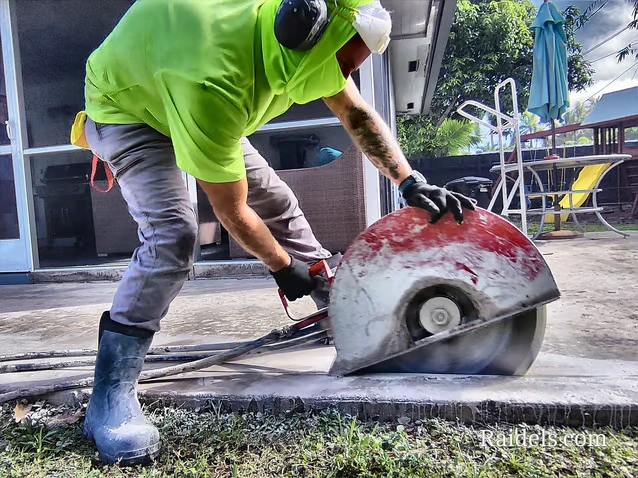
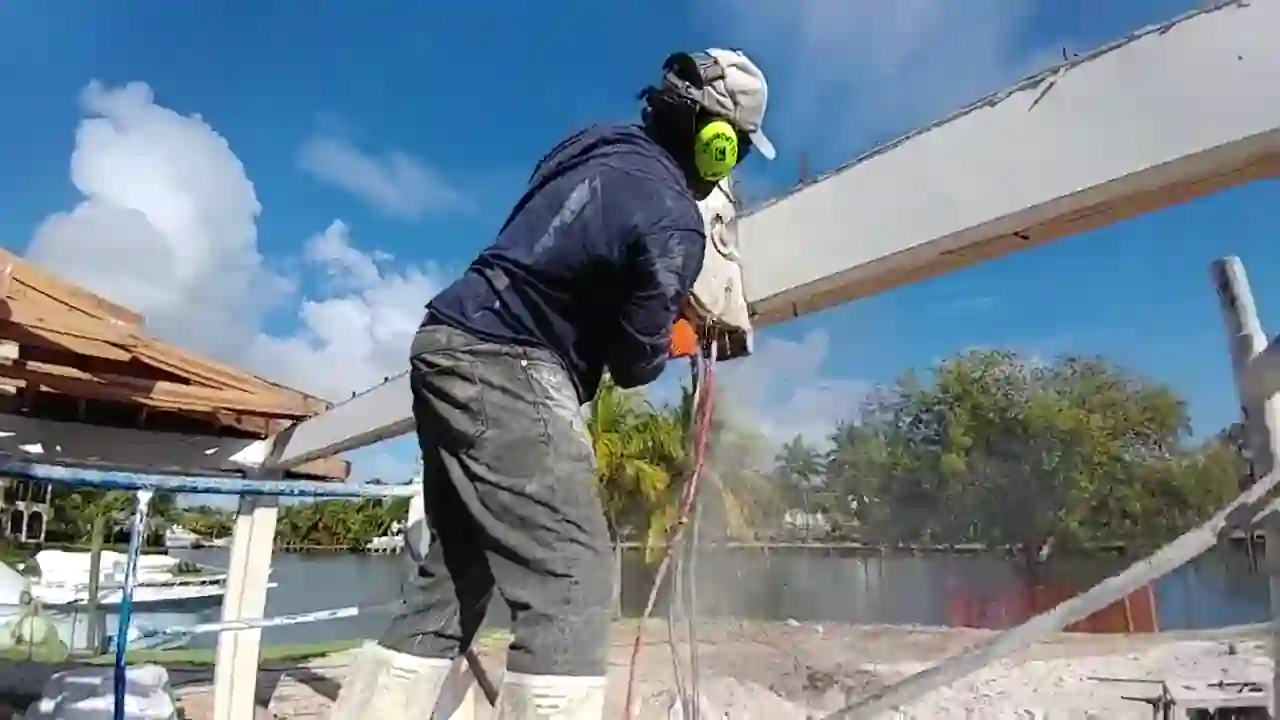
One of the most overlooked waterproofing failure points occurs when new openings are cut into existing waterproofed concrete — for windows, HVAC penetrations, or doorways. Every cut edge is a raw, unsealed concrete face that will wick moisture unless it’s immediately treated. If you’re adding new window openings to a concrete wall, the perimeter of that opening needs crystalline treatment or compatible flashing membrane before any frame installation begins.
Our team handles new window openings in concrete walls with waterproofing integration built into the scope — not as an afterthought. The saw-cut face gets a crystalline slurry coat within 24 hours of cutting, and all anchor points for the frame receive pre-formed grommets or crystalline plug treatment before fastener installation.
For any structural modification that affects load paths, always verify the work against structural safety guidelines before proceeding with waterproofing — sealing a compromised structural element doesn’t fix the structural problem, it hides it.
Maintenance Intervals and Inspection Protocols for Miami Waterproofing Systems
Even the best-installed waterproofing system in Miami requires a scheduled inspection and maintenance protocol. UV degradation of polyurethane topcoats, root intrusion at membrane laps, and thermal cycling fatigue at termination points all create failure pathways over time. Here’s a practical maintenance schedule for South Florida conditions:
- Annual inspection: Walk all horizontal surfaces after the first major rainstorm of the season. Look for blistering, delamination, standing water at low points, and crack propagation through the coating film.
- Every 3 years: Perform adhesion pull-off tests per ASTM D4541 at representative locations. Minimum acceptable adhesion for polyurethane coatings is 200 psi. Below that, plan for recoating within the next 12 months.
- Every 5 to 7 years: Budget for a topcoat refresh on exposed polyurethane systems. The base coat typically retains integrity, but UV exposure degrades the topcoat’s elongation and crack-bridging capability.
- After any seismic event or significant settlement: Inspect all penetrations and termination points immediately. Miami sits on limestone karst, and localized settlement events are more common than most property owners realize.
For a deeper dive into related concrete services and technical guides, visit our full contractor blog where we cover everything from saw cutting tolerances to rebar exposure repair in salt-air environments.
Concrete waterproofing in Miami isn’t a product decision — it’s a system decision driven by substrate condition, moisture pathway, exposure class, and service life requirements. Get those four variables right, and your waterproofing investment will outlast the structure it’s protecting. Get them wrong, and you’ll be doing remediation in 18 months at three times the original cost. The diagnostic work upfront is never wasted time.