Why concrete cutting and drilling are always discussed together — and why they are actually two different skill sets
Concrete cutting and drilling appear together in company names, service listings, and search queries so consistently that many people assume they are essentially the same thing — just different directions of cutting. They are not. Concrete cutting — whether flat sawing, wall sawing, wire sawing, or hand sawing — uses a rotating diamond blade to create linear cuts through concrete. The tool path is straight, the cut is continuous, and the goal is to separate concrete along a defined line. Concrete drilling — primarily core drilling — uses a hollow cylindrical bit with diamond segments on the leading edge to remove a circular core of concrete, leaving a precise round hole. The tool path is circular, the cut removes a defined volume of material rather than separating along a line, and the goal is to create a penetration — for a pipe, a conduit, a duct, an anchor bolt, or a structural connection.
On almost every construction and renovation project in Miami, concrete cutting and drilling are used together. A commercial building renovation needs a new door opening cut through a concrete wall (cutting) and core-drilled holes through the floor slab for plumbing risers and electrical conduits (drilling). A residential pool deck removal needs the perimeter saw-cut to separate the deck from the coping (cutting) and core-drilled anchor holes for the new railing posts that will be installed (drilling). A industrial facility upgrade needs trenches cut through the floor slab for new equipment power feeds (cutting) and core-drilled penetrations through the foundation wall for upgraded utility connections (drilling). The two methods are distinct, but they are almost never deployed in isolation — they are complementary services that address different modification needs on the same structure. A contractor who performs both concrete cutting and drilling eliminates the coordination gap between two separate subcontractors, where each can blame the other for delays, conflicts, or unexpected conditions.
Concrete cutting methods — the linear side of the equation
The cutting half of concrete cutting and drilling encompasses several distinct methods, each optimized for specific applications. Understanding which method fits your project helps you evaluate whether a contractor is proposing the right approach.
Flat sawing (slab sawing)
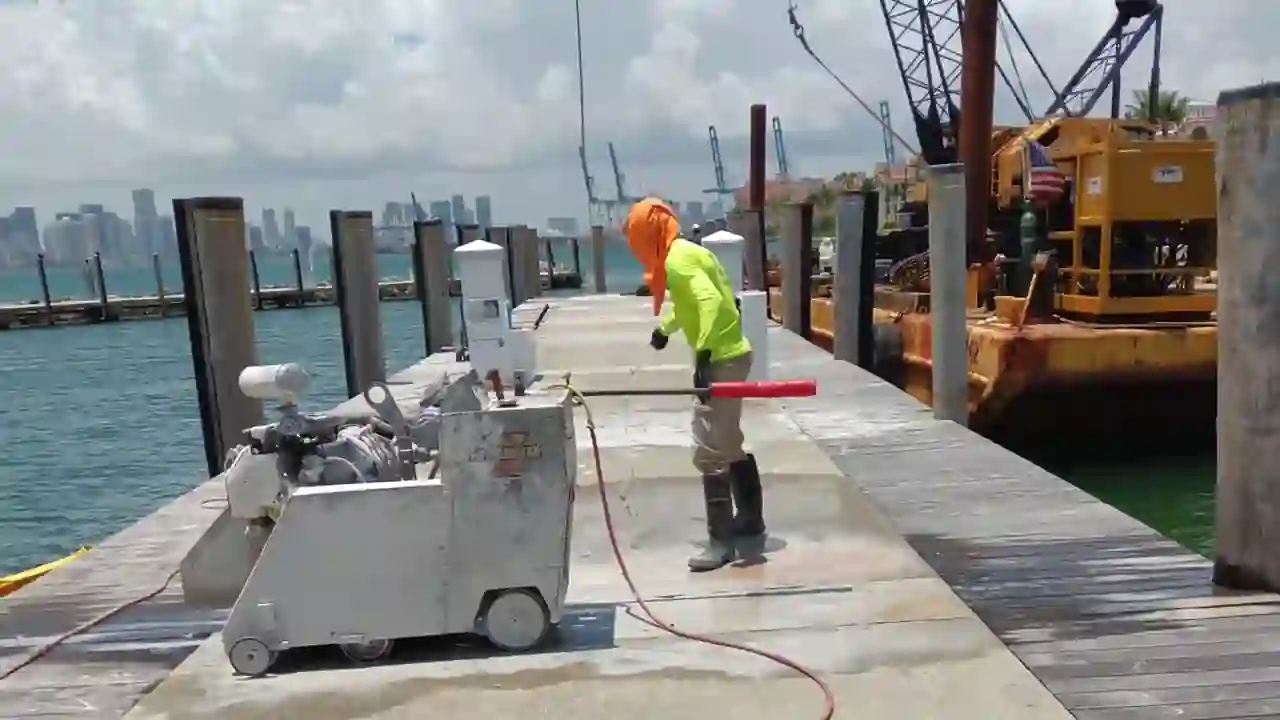
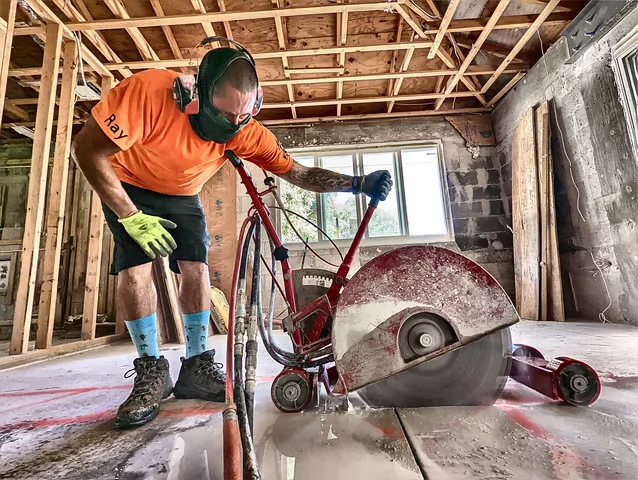
Flat sawing uses a walk-behind or ride-on saw with a diamond blade to cut horizontal concrete surfaces — floors, slabs, pavement, bridge decks. The saw travels along the cut line on wheels or tracks, and the blade depth is adjustable from a fraction of an inch to the full slab thickness depending on blade diameter. Flat sawing is the primary method for cutting control joints, creating trenches for plumbing and electrical rough-ins, sectioning slabs for removal, and cutting expansion joints in pavement. In Miami, slab sawing is the most frequently performed concrete cutting operation.
Wall sawing (track sawing)
Wall sawing mounts a diamond blade on a track system that is attached to a vertical or overhead concrete surface — walls, ceilings, inclined ramps. The saw head travels along the track under power, producing a cut that is straight and plumb over the entire length of the track. Wall sawing creates door and window openings through concrete walls, removes sections of retaining walls, cuts openings for ductwork and mechanical penetrations, and sections concrete walls for demolition. Wall sawing is the method used for most structural wall modifications in Miami buildings.
Wire sawing
Wire sawing uses a continuous loop of steel cable embedded with diamond segments, driven through the concrete by a power unit with hydraulic tensioning. The wire can be threaded through a small cored hole and then wrapped around the concrete section to be cut, allowing cuts through massive concrete sections with no size limitation other than the length of the wire. Wire sawing is used for cutting bridge piers, dam structures, large foundations, and thick concrete walls where a circular blade cannot reach through the entire thickness. Wire saws handle concrete sections measured in feet, not inches.
Hand sawing
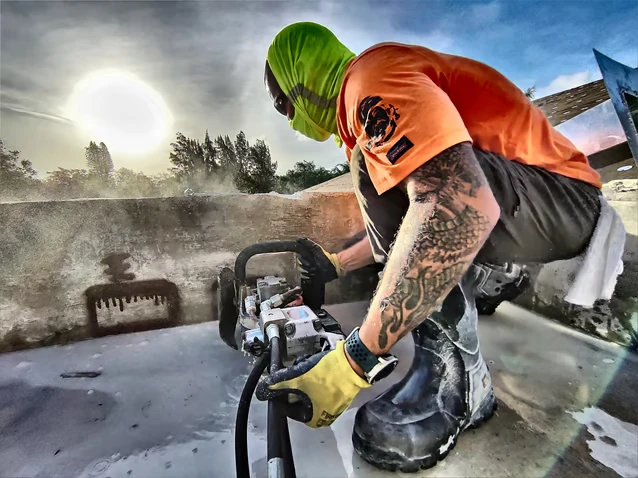
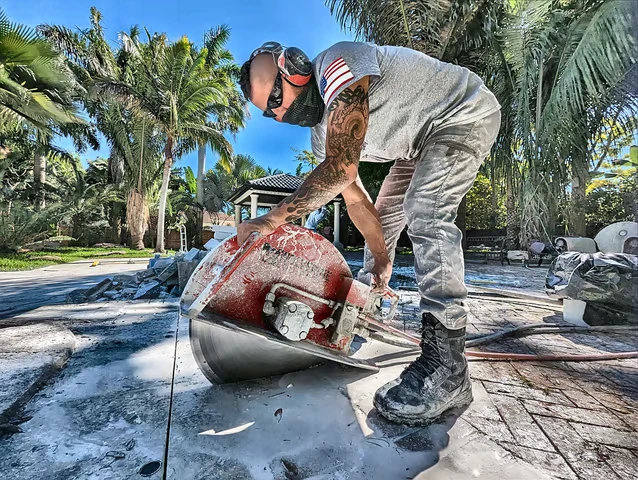
Handheld saws — gas, electric, or hydraulic — make cuts where larger saws cannot physically reach. Tight-access spaces, corner finishing of wall openings, small utility access cuts, and overhead cutting in confined areas are all hand sawing applications. It is slower per linear foot than track-mounted equipment but is often the only viable method for challenging access conditions.
Concrete drilling methods — the circular side of the equation
The drilling half of concrete cutting and drilling primarily means core drilling, though there are variations depending on the hole diameter, depth, and application.
Core drilling
Core drilling uses a diamond-tipped cylindrical bit rotating at high speed to cut a circular path through concrete. A solid core of concrete remains inside the bit and is extracted when the bit is withdrawn. Core holes range from small diameters — half-inch holes for anchor bolts and chemical anchors — to large diameters — 12 inches, 18 inches, or more for major plumbing risers, elevator shaft penetrations, and HVAC duct openings. Core drilling rigs are mounted to the floor or wall using vacuum bases, expansion anchors, or bracing systems to hold the rig steady during drilling. The rig feeds the bit into the concrete at a controlled rate, and water is delivered to the cutting surface for cooling and dust suppression.
Stitch drilling
When a square or rectangular opening is needed but wall sawing is impractical — due to access, concrete thickness, or the need for rounded corners — stitch drilling creates the opening by drilling a series of overlapping core holes along the perimeter. The individual cores remove most of the material, and the remaining concrete webs between the holes are broken out. Stitch drilling is slower and more labor-intensive than wall sawing for large openings, but it works in situations where a track-mounted saw cannot be installed.
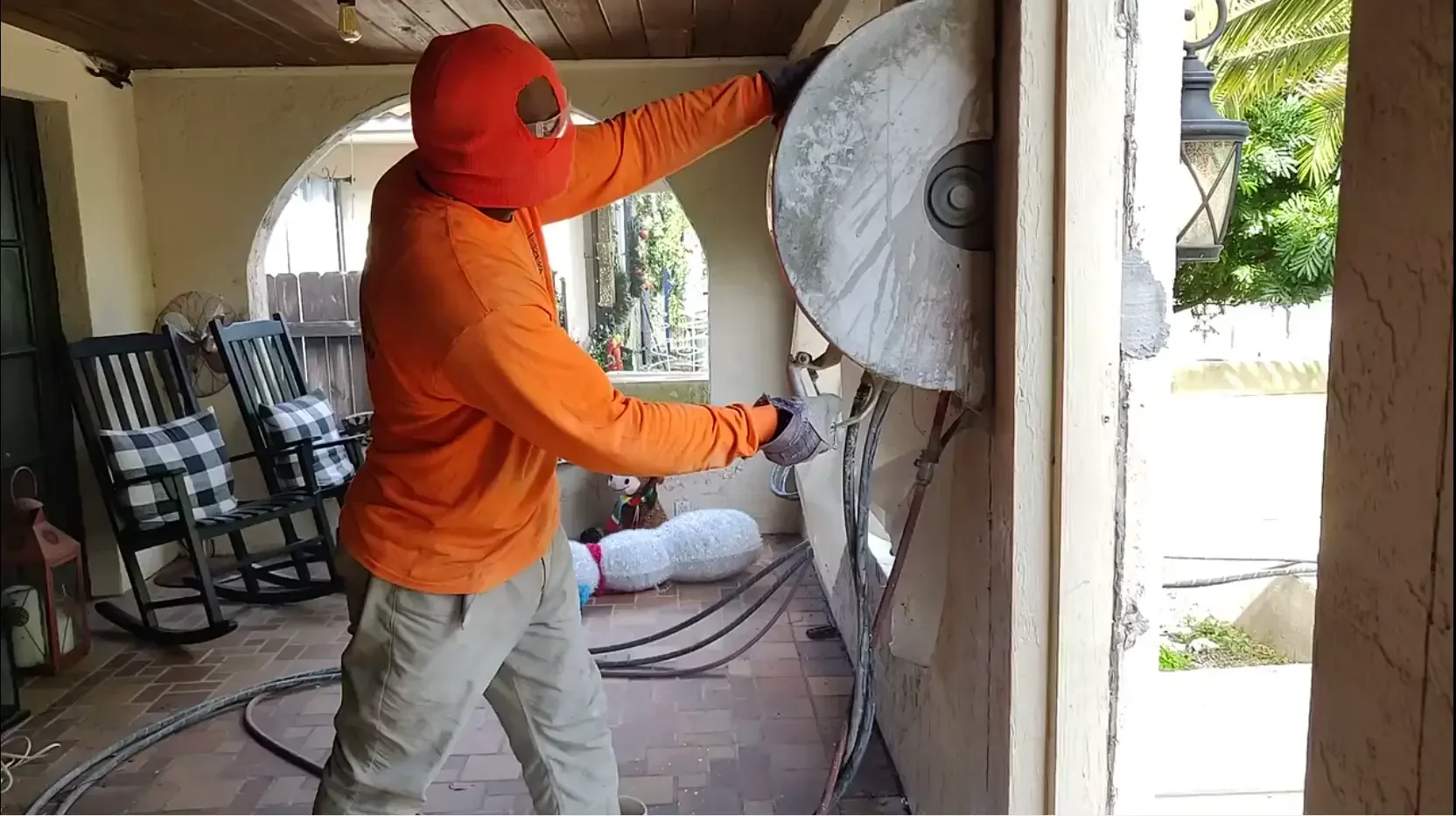
How concrete cutting and drilling work together on typical Miami projects
Here is how concrete cutting and drilling complement each other on real projects we perform regularly in Miami-Dade County.
- Commercial tenant improvement: A retail space in a Miami concrete building needs a new accessible entrance. Wall sawing cuts the door opening through the exterior concrete wall. Core drilling creates holes through the interior slab for plumbing connections to the new bathroom. Flat sawing cuts trenches in the slab for electrical conduit runs from the panel to the point of sale counter. All three methods deployed on the same project, by the same contractor, with coordinated scheduling.
- Residential pool demolition: Concrete cutting separates the pool deck from the coping and sections the deck slab for removal. Core drilling creates drainage holes through the pool floor to prevent water accumulation after backfilling. The cutting and drilling are planned together because the equipment and crew are already mobilized on site.
- Industrial equipment installation: A new manufacturing machine requires a foundation pad modification. Flat sawing cuts the outline of the new pad depression in the existing floor. Core drilling creates holes for the anchor bolts that will secure the machine to the new concrete. The core holes must be precisely located relative to the saw-cut edges — coordination that is straightforward when the same contractor performs both operations.
- Elevator shaft modification: An existing elevator shaft needs a new door opening on a floor previously served by a different elevator bank. Wall sawing cuts the door opening through the shaft wall. Core drilling creates holes for the elevator control wiring penetrations. Both operations require precision — a misaligned door opening or a core hole in the wrong location creates problems that are expensive to fix in a finished shaft.
Choosing a concrete cutting and drilling contractor in Miami
When your project requires both concrete cutting and drilling, hiring a single contractor who performs both services eliminates the coordination problems that arise when two separate contractors work in the same area on overlapping schedules. A contractor who does not perform drilling will need to coordinate with a separate drilling contractor, and each one will operate on their own schedule, with their own equipment mobilization, their own interpretation of the plans, and their own tendency to point at the other contractor when something does not line up correctly.
A qualified concrete cutting and drilling contractor in Miami should own or have reliable access to the full range of equipment — flat saws, wall saws, wire saws, hand saws, core drilling rigs with multiple bit sizes, and GPR scanning capability either in-house or through a trusted subcontractor. They should be able to show you photographs and references from projects similar to yours that involved both cutting and drilling — not just one or the other. They should include silica dust control and slurry containment explicitly in their scope of work. And they should manage the entire sequence — scanning, cutting, drilling, debris removal, and site cleanup — as a single coordinated operation rather than a series of disconnected subcontractor visits. Contact us to discuss your project and receive a scope of work that integrates concrete cutting and drilling from start to finish.