Technical Overview of High-Strength Concrete Removal in Miami’s Urban Environment
Miami’s subtropical climate, high water table, and prevalence of heavily reinforced concrete structures demand a level of precision and control that conventional jackhammering simply cannot deliver. When we talk about concrete removal miami, we are referring to a suite of engineered demolition methods that prioritize structural integrity, noise reduction, and environmental compliance. Whether you are removing a 12-inch thick foundation slab in Brickell or a post-tensioned bridge deck in Hialeah, the choice of equipment and technique directly impacts project timelines, safety margins, and cost efficiency. This guide draws on decades of field experience to break down the most effective approaches for removing concrete in Miami’s unique subsurface conditions.
Hydraulic Splitting vs. Diamond Wire Sawing for Reinforced Concrete
Two dominant methods for controlled concrete removal in Miami are hydraulic splitting and diamond wire sawing. Hydraulic splitters (also known as hydro-bursters) exert expansive force within pre-drilled holes, fracturing the concrete along predetermined planes. This is ideal for thick, unreinforced or lightly reinforced slabs where vibration must be minimized. However, when rebar density exceeds #5 bars at 6-inch spacing, diamond wire sawing becomes the superior choice. The wire loop, impregnated with industrial-grade diamond beads, can cut through both aggregate and steel reinforcement in a single pass. For a detailed breakdown of how these techniques apply to large-scale commercial projects, see our guide on commercial concrete solutions.
Controlled Demolition with Micro-Hydraulic Bursters
In tight urban sites like Coral Gables or South Beach, where adjacent structures are within feet of the removal zone, micro-hydraulic bursters offer unparalleled precision. These units operate at pressures exceeding 10,000 psi, expanding a steel wedge inside a 1.5-inch diameter hole. The resulting tensile fracture propagates along the line of least resistance, leaving rebar intact for later cutting. This method is particularly effective for removing concrete around existing utilities or post-tension cables. The hydraulic category on our site provides additional case studies on pressure parameters and hole spacing calculations.
Rebar Sawing and Core Drilling for Precision Removal
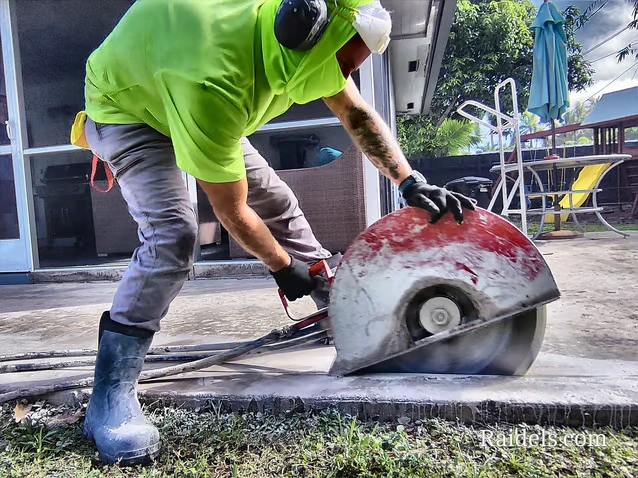
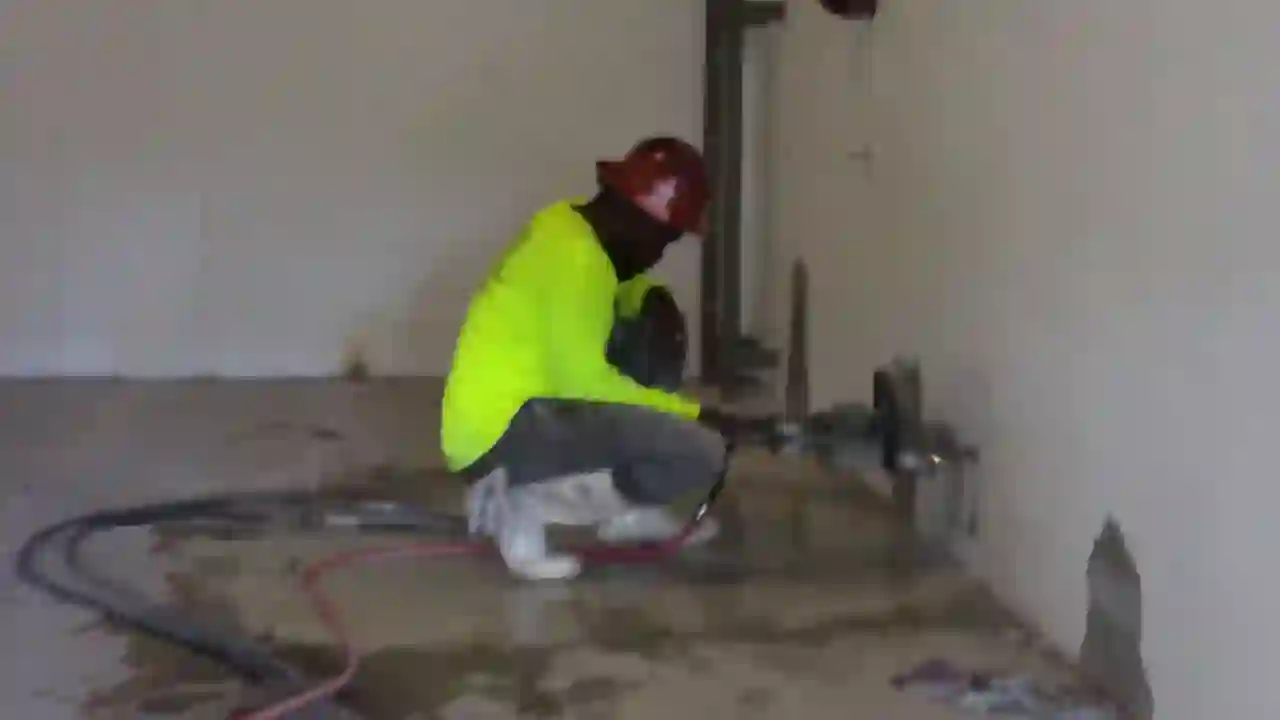
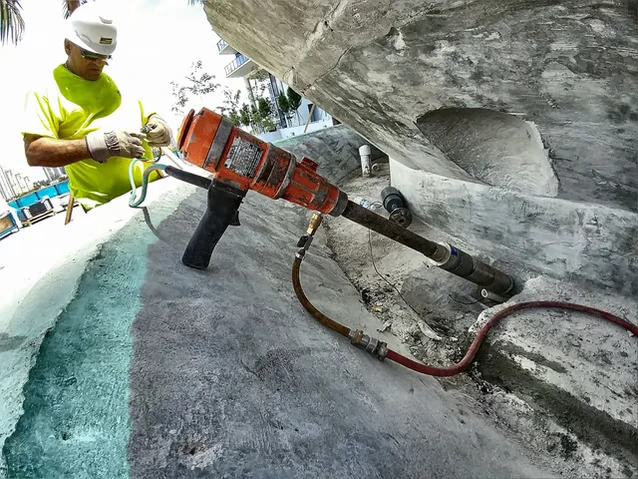
After the bulk concrete is fractured or sectioned, rebar must be severed cleanly to allow for removal. Standard abrasive saws struggle with epoxy-coated or stainless steel rebar common in Miami marine environments. Instead, we employ diamond-segmented rebar saws with a minimum 14-inch blade diameter, running at 2,500 RPM with water cooling. Core drilling is often used in tandem to create relief holes or to extract full-depth samples for compressive strength testing. For more on this specific technique, refer to our concrete sawing with rebar tag page.
Environmental Considerations: Slurry Management and Dust Control
Concrete removal generates two primary environmental hazards: silica-laden dust and alkaline slurry. Miami-Dade County regulations require containment of all runoff to prevent contamination of storm drains and the Biscayne Aquifer. We use vacuum-assisted dust shrouds on all saws and grinders, along with portable settling tanks for slurry. The pH of the slurry is neutralized with citric acid before disposal. Additionally, when working near sensitive landscapes such as rain gardens or bioswales, we deploy silt fencing and absorbent booms. Our rain gardens tag page details best practices for protecting these features during demolition.
Structural Integrity Assessment Before Removal
Before any cutting begins, a senior consultant must evaluate the load path and reinforcement layout. Miami’s building stock includes many structures built before modern seismic codes, where removal of a single column could trigger progressive collapse. We use ground-penetrating radar (GPR) to map rebar and post-tensioning tendons, then mark cut lines with survey-grade accuracy. For slabs-on-grade, we also check for vapor barriers and underslab drainage systems that could be compromised by vibration. A thorough pre-removal assessment is non-negotiable for safe concrete removal miami operations.
Equipment Selection for Miami’s Subsurface Conditions
The limestone base common in Miami-Dade County presents unique challenges. Abrasive wear on diamond blades and wires is accelerated by the silica content in the aggregate. We counter this by using high-bond diamond segments and increasing water flow to maintain cooling. For deep cuts (over 24 inches), we deploy wire saws with 11mm diameter beads and a line speed of 20-25 m/s. Track-mounted wall saws are preferred for vertical cuts due to their rigidity and precision. For a comprehensive overview of Miami-specific techniques, see The Miami Concrete Jungle: A Guide to Cutting and Removing Concrete Slabs.
Post-Tensioned Concrete Removal: Special Precautions
Post-tensioned (PT) slabs are common in Miami high-rises and parking garages. Cutting into a live PT tendon can cause catastrophic failure. We always verify tendon locations with GPR and X-ray, then cut only after stressing is relieved. The preferred method is to cut a small access hole, install a stressing jack, and detension the tendon before sawing. For unbonded PT, we use a specialized wedge system to lock the tendon while cutting. This is one area where experience literally saves lives.
Noise and Vibration Mitigation in Occupied Buildings
Many concrete removal projects in Miami occur in occupied hospitals, hotels, or office buildings. Standard hydraulic breakers produce 90-110 dB, which is unacceptable in sensitive environments. We use electric-powered hydraulic power packs with sound attenuation enclosures, and schedule the highest-impact work during off-hours. For vibration-sensitive equipment (e.g., MRI machines, data centers), we employ stitch drilling with a 4-inch core bit to create a perforated line, then use a hand-held hydraulic splitter to separate the section. This reduces peak particle velocity (PPV) to below 0.5 in/s.
Cost Optimization Through Section Size Planning
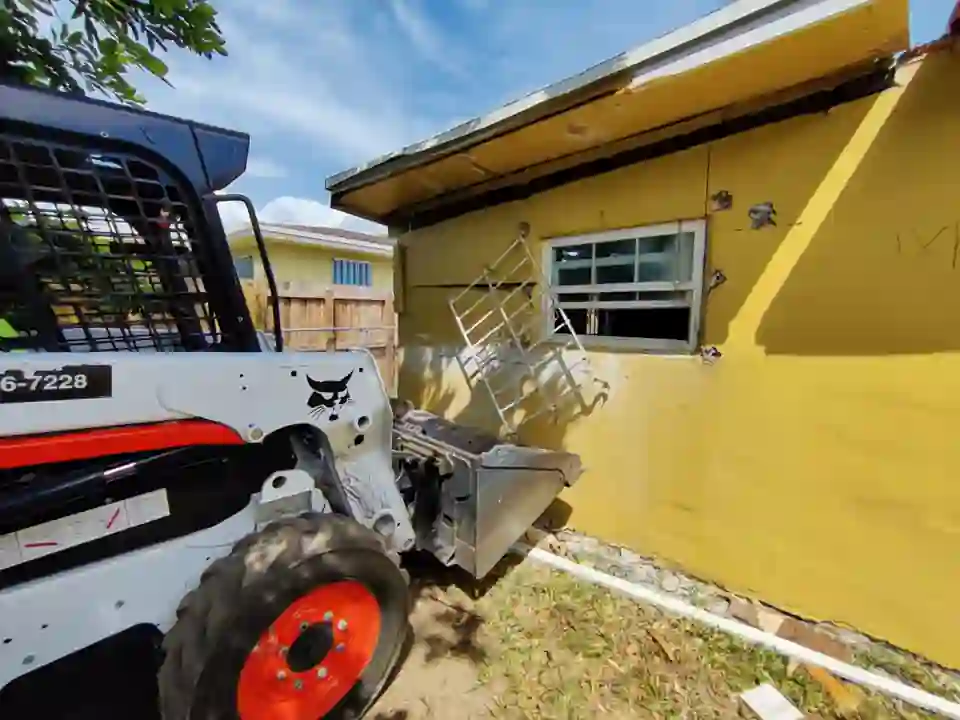
Efficient concrete removal miami projects are built on proper section sizing. Each piece must be small enough for the available lifting equipment (crane, forklift, or excavator) but large enough to minimize the number of cuts. For example, a 10×10-foot slab section weighing 15,000 lbs might require a 50-ton crane, while 5×5-foot sections can be handled by a skid steer. We calculate optimal section dimensions based on concrete thickness, rebar density, and access constraints. This reduces total cutting time by up to 30%.
Emergency Concrete Removal for Structural Repairs
When a Miami building suffers impact damage or foundation settlement, rapid concrete removal is critical. We maintain a 24/7 response team with mobile diamond wire saws and hydraulic splitters. In one recent case, a parking garage column was damaged by a vehicle collision, requiring removal of the surrounding slab within 48 hours. We used a combination of stitch drilling and wire sawing to isolate the damaged area without affecting adjacent post-tensioned bays. The project was completed on schedule, and the structure was re-analyzed for load redistribution.
Training and Certification Requirements
All operators on our concrete removal crews hold certifications from the Concrete Sawing and Drilling Association (CSDA) and OSHA 30-hour construction safety. Specialized training includes confined space entry for below-grade removal, fall protection for elevated slabs, and hazardous material awareness for asbestos-containing concrete (common in buildings constructed before 1980). We also conduct weekly toolbox talks on Miami-specific hazards such as sinkhole potential and high water table dewatering.
Final Quality Control and Disposal
After removal, we inspect the cut edges for spalling, delamination, or rebar exposure beyond the specified tolerance. All removed concrete is transported to a certified recycling facility where it is crushed for use as road base or riprap. Steel rebar is separated and sent to scrap metal processors. We provide clients with a disposal manifest and a post-removal report documenting cut locations, depths, and any unforeseen conditions encountered. This documentation is essential for insurance and warranty purposes.
Concrete removal in Miami is not a one-size-fits-all operation. From hydraulic splitting in tight urban alleys to diamond wire sawing on high-rise balconies, the right method depends on structural conditions, environmental constraints, and project deadlines. By combining advanced equipment with decades of local experience, we deliver safe, efficient, and code-compliant removal every time.