How concrete cutting technology has changed what is possible in concrete modification
Fifty years ago, cutting an opening in a reinforced concrete wall meant drilling a series of holes around the perimeter with a hammer drill, knocking out the center with a sledgehammer, and chipping the edges with a chipping hammer until the opening was roughly the right size and shape. The process took a day or more, produced a ragged opening, and transferred devastating vibration throughout the structure. The concrete cutting technology available today — diamond blades with engineered bond matrices, hydraulic wall saws that ride on precision tracks, ground-penetrating radar that reveals what is inside the concrete before the blade touches it — has made that approach obsolete, unsafe, and unthinkable for professional contractors.
Modern concrete cutting technology is built on three pillars: diamond blade engineering, which determines how efficiently and cleanly a blade cuts through specific concrete compositions; power and guidance systems, which deliver consistent cutting energy and control the blade path with millimeter precision; and pre-cut assessment technology, which eliminates the unknowns that used to make concrete cutting a high-stakes gamble. Together, these technologies allow a professional concrete cutting contractor to cut a straight, clean, accurately sized opening through a heavily reinforced 12-inch concrete wall in a few hours, with no vibration damage to the surrounding structure and edges ready for door frame installation. The technology is the difference between a rough hole and a precision opening.

We invest continuously in concrete cutting technology — upgrading blades, saws, scanning equipment, and dust control systems as the technology advances. In Miami’s competitive construction market, the technology is what separates concrete cutting specialists from contractors who cut concrete as an incidental activity. The saw matters. The blade matters more. And the scanning technology that tells the operator what is inside the concrete matters most of all.
Diamond blade technology: the core of concrete cutting
The diamond blade is the single most important piece of technology in concrete cutting. A modern diamond blade is not a simple steel disc with diamonds glued to the edge. It is a precisely engineered cutting tool where the diamond type, diamond concentration, diamond size, segment geometry, and bond matrix (the metal alloy that holds the diamonds) are all controlled to optimize cutting performance for specific materials and conditions.
The key technology elements of a modern diamond blade:
Synthetic diamond
The diamonds in a concrete cutting blade are synthetic — manufactured under high temperature and pressure to produce crystals with controlled size, shape, and friability (the tendency of the diamond to fracture and expose fresh cutting edges). Diamond size is measured in mesh — larger numbers indicate smaller diamonds. A 30/40 mesh diamond is coarse and used for soft materials where fast cutting is the priority. A 50/60 mesh diamond is finer and used for hard materials where blade life is the priority. The diamond type, size, and concentration in the segment are engineered for the specific material the blade is designed to cut. A blade for cutting plain concrete uses a different diamond specification than a blade for cutting reinforced concrete with steel rebar.
Metal bond matrix
The bond is the metal alloy that holds the diamonds in the segment. As the blade cuts, the bond wears away at a calibrated rate, continuously exposing fresh diamonds while retaining diamonds that still have cutting life. The bond hardness is the most critical variable in blade performance. Too hard a bond for the material being cut, and the blade glazes — the diamonds wear down but the bond does not release them, so the blade stops cutting. Too soft a bond, and the diamonds are released before they are fully used, causing rapid blade wear. Professional concrete cutting contractors select blades with bond hardness matched to the specific concrete they are cutting — soft bonds for hard aggregate, hard bonds for soft aggregate, and medium bonds for the mixed conditions typical of Miami’s limestone-aggregate concrete.
Segment design
Diamond segments are not uniform blocks. Modern segments use layered or sandwich construction — alternating layers optimized for different parts of the cutting process. A blade for cutting reinforced concrete may use layers optimized for concrete alternating with layers optimized for steel. The layers wear at different rates, creating a channeled segment profile that improves cooling, swarf (cutting debris) removal, and cutting efficiency. Segment geometry — width, height, and the shape of the gap between segments — is engineered to balance cutting speed, blade life, and the specific demands of wet or dry cutting.
Laser welding and segment attachment
The diamond segments are attached to the steel core by laser welding or brazing. Laser welding provides a stronger bond and higher heat resistance, allowing the blade to operate at higher temperatures — important for dry cutting and for cutting through steel rebar where friction heating is significant. The steel core itself is precision-manufactured with tensioning to maintain stability at operating RPM, and some cores incorporate noise-reduction technology — laser-cut slots or a sandwich construction that dampens the ringing that makes concrete cutting so loud.
Hydraulic wall saw technology
The hydraulic wall saw is the most technologically advanced saw in the concrete cutting arsenal. A hydraulic wall saw system consists of three components:
- Hydraulic power unit: A diesel, gas, or electric engine driving a hydraulic pump that delivers high-pressure hydraulic fluid to the saw head. The power unit is separate from the saw — connected by hydraulic hoses — allowing the saw head to be lighter and more compact than if it carried its own motor.
- Track system: An aluminum or steel track that mounts to the concrete wall using expansion anchors or vacuum pads. The track provides a rigid, straight guide for the saw head and can be extended with additional track sections for long cuts. The track is aligned to the cut line with precision — typically within 1/16 inch over the full cut length.
- Saw head: The assembly that rides on the track, containing the hydraulic motor that spins the blade and the feed mechanism that advances the blade into the cut. The saw head provides control over blade RPM, feed rate, and cutting depth. Some modern wall saws incorporate electronic controls that optimize feed rate based on blade load, maintaining consistent cutting speed regardless of variations in concrete hardness or rebar encounters.
The technology advantage of hydraulic wall saws over electric or gas-powered alternatives is consistent power delivery. When the blade encounters rebar or a hard aggregate inclusion, the load on the saw motor increases. An electric or gas motor may bog down under this load spike, slowing the blade and causing uneven cutting. A hydraulic motor, fed by a constant-pressure hydraulic power unit, instantly compensates by increasing torque to maintain RPM. This consistent cutting speed produces straighter cuts, longer blade life, and faster completion times — particularly in reinforced concrete where load variation is continuous as the blade alternates between concrete and steel.
GPR scanning: the technology that eliminates the unknown
Ground-penetrating radar has transformed concrete cutting safety. Before GPR, a contractor started cutting and hoped the blade did not hit anything dangerous — a live electrical conduit, a post-tension cable under thousands of pounds of tension, a plumbing line full of pressurized water. The consequences of hitting these unknowns ranged from expensive repairs to catastrophic injury. GPR eliminates the unknown.
GPR works by transmitting electromagnetic pulses into the concrete and recording the reflections. Different materials — rebar, conduit, PT cables, voids, changes in concrete density — reflect the signal differently. The GPR antenna is moved across the concrete surface in a grid pattern, and the data is processed into a subsurface map showing the location and depth of embedded objects. Modern GPR systems can detect rebar as small as #3 (3/8 inch) at depths up to 18 inches in concrete, and can differentiate between closely spaced parallel objects — distinguishing a rebar mat at 2 inches depth from an electrical conduit at 3 inches.
The GPR scan result is marked directly on the concrete surface — typically with spray paint or chalk — showing the exact location of rebar, conduits, PT cables, and any other detected objects. The cutting plan is then adjusted to avoid these hazards. If a cut line must cross a rebar mat, the blade selection accounts for it — a blade rated for metal is selected. If a cut line conflicts with a PT cable, the line is shifted — PT cables must not be cut. GPR scanning is the technology that converts concrete cutting from a reactive process (discovering hazards by hitting them) to a planned process (knowing what is there before the blade arrives).
Wire sawing technology for the largest cuts
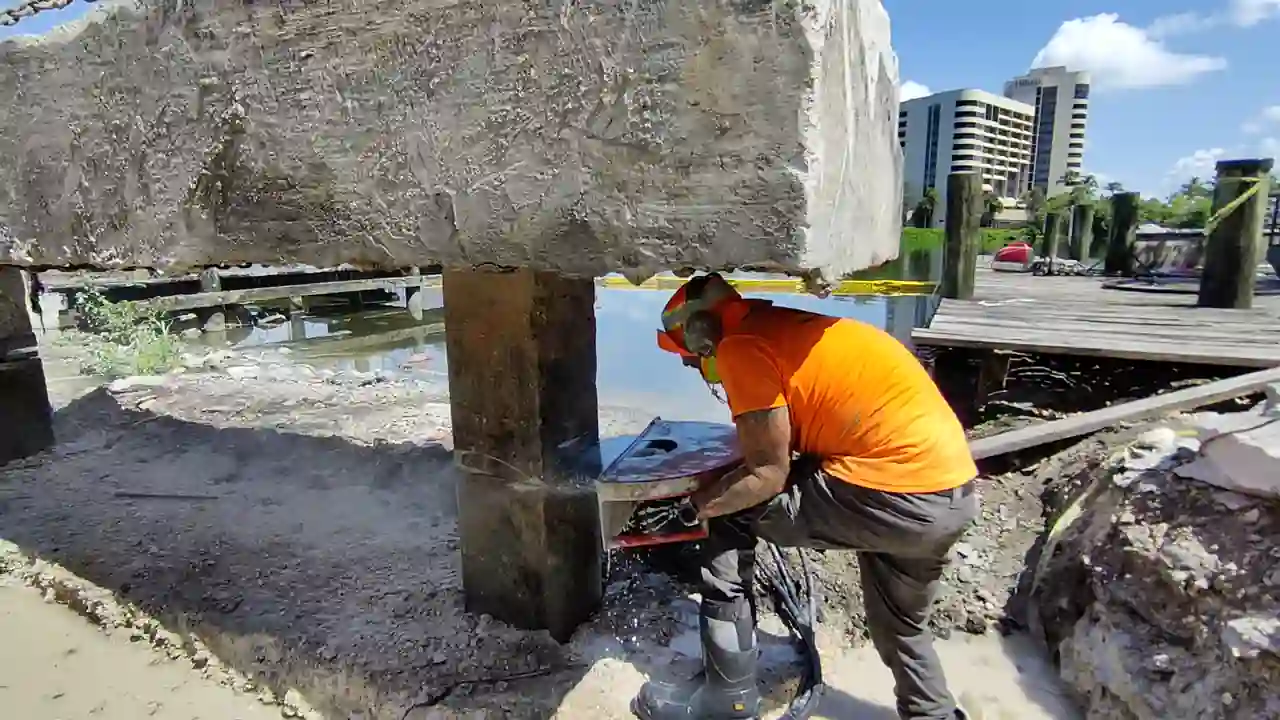
Wire sawing uses a diamond-impregnated wire cable threaded through a series of pulleys and driven by a hydraulic power unit. The wire is wrapped around the concrete structure to be cut, and as the wire runs through the pulleys, the diamond beads on the wire grind through the concrete. Wire sawing can cut through concrete of virtually any thickness — the only limitation is the length of the wire and the capacity of the power unit. It is used for cutting massive structures that exceed the reach of any circular blade: bridge piers, thick foundation walls, large columns, and industrial concrete structures.
Wire sawing technology has advanced significantly in the last two decades. Early wire saws used spring-mounted diamond beads that were prone to losing tension and slipping on the wire. Modern wire saws use injection-molded beads that are permanently fixed to the wire, providing consistent cutting performance and eliminating bead slippage. Wire speed, cutting pressure, and cooling water flow are electronically controlled for optimal cutting efficiency. The wire itself is available in different diamond specifications for different concrete compositions — just as circular blades are matched to the material.
How concrete cutting technology benefits Miami property owners
The technology investment that a professional concrete cutting contractor makes — in diamond blades, hydraulic saws, GPR scanners, and related equipment — translates directly to better outcomes for Miami property owners:
- Faster completion: Technology-enabled cutting speeds mean your project finishes on schedule, not extended by days of slow cutting through reinforced concrete.
- Cleaner results: Precision-guided saw cuts produce clean edges that are ready for door frames, window installation, pipe sleeves, or whatever comes next — no grinding, chipping, or patching required to clean up a rough cut.
- No surprises: GPR scanning eliminates the unknowns that used to make concrete cutting a gamble. The cutting plan is based on data, not guesswork.
- Safer process: Technology-controlled cutting with engineered dust suppression produces a safer job site for workers and for building occupants.
Concrete cutting technology is an investment that professional contractors make on behalf of their clients. The technology shows up in the cut quality, the project schedule, and the absence of the problems that used to be accepted as part of cutting concrete. When you hire a concrete cutting contractor, you are hiring their technology as much as their labor. Make sure the technology is current.